The civilización inka administered one of the largest and most complex societies of the pre-industrial world — spanning vast territory and coordinating agriculture, labor, taxation, and resource distribution across extraordinarily difficult terrain. Doing so required sophisticated systems for calculation and record-keeping. These systems, the yupana and the khipu, represent a form of mathematical and administrative intelligence entirely distinct from the Western and Arabic traditions — and much of their sophistication remains only partially understood.
The Yupana: An Analog Calculator
The yupana was a calculating device — in effect, an analog calculator for manual computation. Built as a grid of compartments, it allowed its operator to perform mathematical operations through the positional arrangement of tokens such as seeds or pebbles.
Long before electronic calculators, the civilización inka had engineered a physical device for rapid, positional computation.
What makes the yupana significant is that it embodies a positional number system — a method of representing values by position, which is the same fundamental principle underlying modern arithmetic. Just as Arabic mathematics developed shortcuts and formulas for computation, the Inka developed their own methods. Much of this knowledge was lost or suppressed following the conquest, but the surviving evidence points to a genuine and independent mathematical tradition.
The Khipu: Records in Knotted Cord
The khipu was a system of record-keeping made of knotted cords. Different knot types, positions, colors, and cord arrangements encoded information. It is now widely accepted that khipus recorded censuses, accounting, tribute, and administrative data — the essential information required to run a large state.
But the khipu may be more than an accounting tool. Researchers continue to investigate whether it also encoded language itself — whether it functioned as a form of writing as well as a numerical record. Scholars at institutions including Harvard University have studied collections of khipus, identifying numerous distinct knot types and exploring parallels to binary and other encoding systems.
Harvard researchers studying khipus have compared their structure to a binary system — and openly acknowledge how much about them remains unknown.
This ongoing research is itself telling. Some of the world’s leading universities hold knowledge about these systems that even dedicated students of Andean culture do not fully possess — and yet, by the researchers’ own admission, much remains undeciphered. The khipu guards its secrets still.
The Tocapu: Encoded in Textiles
A third system, the tocapu, consisted of geometric designs woven into textiles or painted in iconography. These were not merely decorative. The tocapu appear to have carried encoded meaning — a complex system of communication expressed through visual and textile patterns whose full significance has not been recovered.
Together, the yupana, khipu, and tocapu represent an integrated set of technologies for calculation, record-keeping, and communication. They are basic arts of administration in the sense of being foundational — but the information they encoded was complex, coherent, and sufficient to coordinate a vast civilization.
A Different Kind of Intelligence
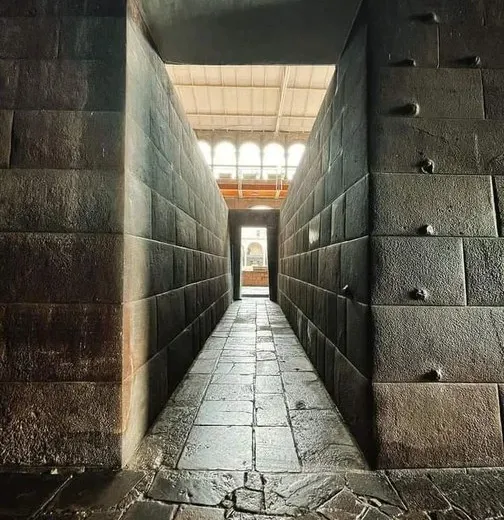
The significance of these systems goes beyond their function. They demonstrate a form of mathematical and organizational intelligence fundamentally different from the Western tradition, yet clearly capable of supporting achievements of remarkable scale. The precision of Inka engineering and architecture — stonework and construction that continue to challenge modern understanding — required exactly this kind of sophisticated calculation and coordination.
You cannot build what the Inka built without advanced systems of calculation. The evidence is in the stones — and in the knotted cords that recorded how it was done.
What Was Lost, and What Remains
Much of this knowledge was lost in the aftermath of conquest, as the systems that sustained it were dismantled and their keepers scattered. What survives is fragmentary — enough to demonstrate sophistication, but not enough to fully reconstruct the knowledge itself.
This is a recurring theme in the study of the civilización inka and other invaded cultures: the evidence of advanced understanding is undeniable, yet the full knowledge has been obscured or destroyed. Approaching these systems honestly — recognizing both their sophistication and how much remains unknown — is central to the Inka Method’s treatment of history not as a settled story, but as a body of evidence still being recovered.
The yupana and khipu are not primitive curiosities. They are the visible remnants of a mathematical intelligence whose full depth was lost — and is only now being pieced back together.